The amount of available environmental data has exploded in past five years thanks to improvements in data collection and big data. By combining seemingly disparate datasets, the accuracy of the global environmental image has improved and has given scientists new insights into how best to conserve the environment.
Satellites have been an integral driver of this data revolution in recent years. Compared with the 1970s, satellite imagery of the earth is now 20 times higher in quality, with images being sent back to earth 60 times more frequently. Data storage capabilities have increased from less than 2 exabytes to 4.6 zettabytes thanks to cloud technologies. With this infrastructure in place, collaborations, such as those between NASA and the European Space Agency, have been possible. The two agencies partnered up in 2018 to publish the most complete assessment of Antarctica’s Ice Sheet Mass Balance1. Using imagery from 24 satellite surveys, the study showed that between 1992 and 2017, Antarctica ice loss directly raised global sea levels by 7.6 millimetres. This is in contrast to the IPCC’s (Intergovernmental Panel on Climate Change) statement only a few years earlier that their model predictions showed that future Antarctic ice loss will have a negative contribution to global sea levels. At the current rate of ice loss Antarctica is experiencing, according to the NASA/ESA study, the projections for sea level rise in the near future indicate stark changes in the environment.
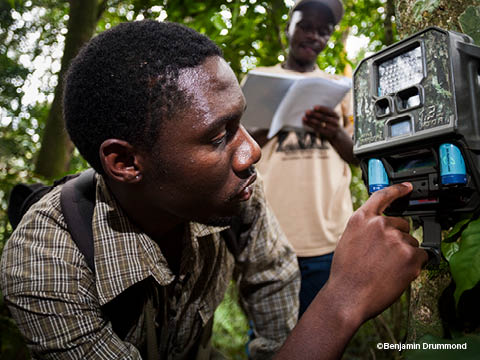
Another demonstration of Big Data in environmental conservation is the work of Wildlife Insights, a collaboration between a number of major animal conservation bodies, including the WWF, Wildlife Conservation Society, and Google. One of the main aims of Wildlife Insights is to make use of the many millions of images produced by camera traps (small cameras that take images when its sensors detect movement) located in the wild around the world. Historically it has been difficult to process these images and extract useful insights from them because of barriers in technology. But with the improvement in Big Data processing tools, as well as analysis techniques such as Artificial Intelligence and Machine Learning, camera trap image processing has given conservationists a better understanding of wild animal populations in jungles, forests and more. Hoping to connect these Big Data insights with decision makers, Wildlife Insights regularly liaise with local governments and land managers so that they can gain a better understanding of the wildlife in their area.2
Whilst big data has had a major impact on environmental studies, it has also aided corporations to better understand their operations and potential contribution to environmental damage. Pirelli is an Italian tire company which puts technology at the front of its business practices. Using HANA, a data management system from SAP, Pirelli has improved transparency in their processes allowing for more efficient detection of defective tires going to landfills. Increases in the speed of the data stream, thanks to the management system, has improved data collection, processing and distribution on all fronts of the company and it has in turn reaped the benefits by meeting waste reduction goals and increasing profits.3
With massive amounts of data comes many challenges in the form of processing, storage and analysis limitations, but without fail, this data gives us a more detailed understanding of the world we live in and the ways we can protect it. Currently, Big Data is playing a vital role in environmental conservation and as it proves to be more accurate in forecasting for the future, decision makers must implement appropriate policies accordingly to tackle these issues and help conserve the environment.
1 https://climate.nasa.gov/news/2749/ramp-up-in-antarctic-ice-loss-speeds-sea-level-rise/
2 https://www.wildlifeinsights.org/about
3 https://sustainablebrands.com/read/cleantech/what-does-big-data-mean-for-sustainability

 The Data Lake
Leave a comment